Pet Food
Policy
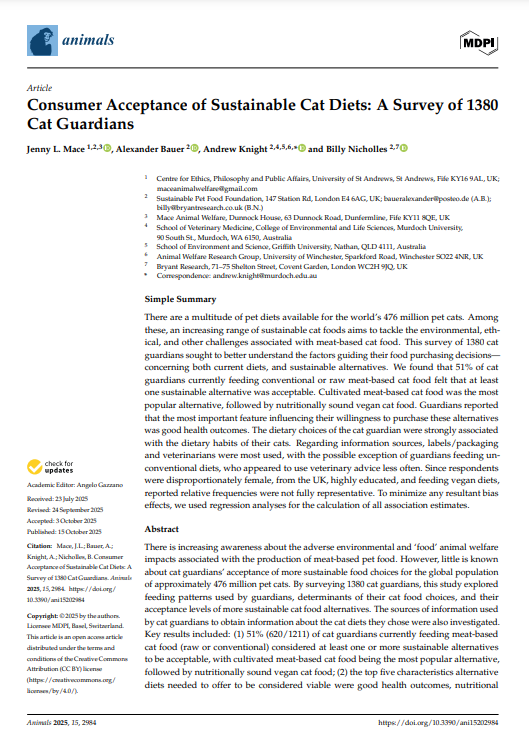
Sustainable Pet Diets: A Leading Effective Altruism Issue
Abstract
While animal-derived ingredients continue to dominate pet food, mounting animal welfare and environmental pressures are starting to reshape the market—opening the door to plant-based and cultivated meat alternatives for dogs and cats. This study assessed the effective altruism case for more sustainable pet food options, using the scale, neglectedness, and tractability framework, and found strong alignment across all three dimensions. By 2018, at least 9% of farmed land animals were fed to companion dogs and cats globally, with more consumed by average dogs (13) than by average people (9) annually. A global transition to nutritionally sound vegan pet diets could spare seven billion farmed land animals and many billions of marine animals from slaughter and could feed 519 million additional people using food energy savings. Such a transition for dogs alone could eliminate 1.5 times the quantity of greenhouse gases produced annually by the UK and free up land larger than Mexico. Yet, sustainable pet food is a highly neglected issue in terms of funding, time, and talent. The issue appears tractable; 13–18% of dog and cat guardians would consider vegan pet diets if their concerns about them were addressed. Assuming only one dog or cat per guardian, at least 70 million dogs and 86 million cats worldwide could potentially be transitioned to vegan diets, with the true figures probably several times higher. Sustainable pet diets, therefore, represent a highly impactful yet overlooked opportunity to reduce farmed animal consumption, mitigate associated environmental impacts, and improve food security.
Knight A. (2026). Sustainable Pet Diets: A Leading Effective Altruism Issue Animals 2026, 16(3), 460. https://doi.org/10.3390/ani16030460.
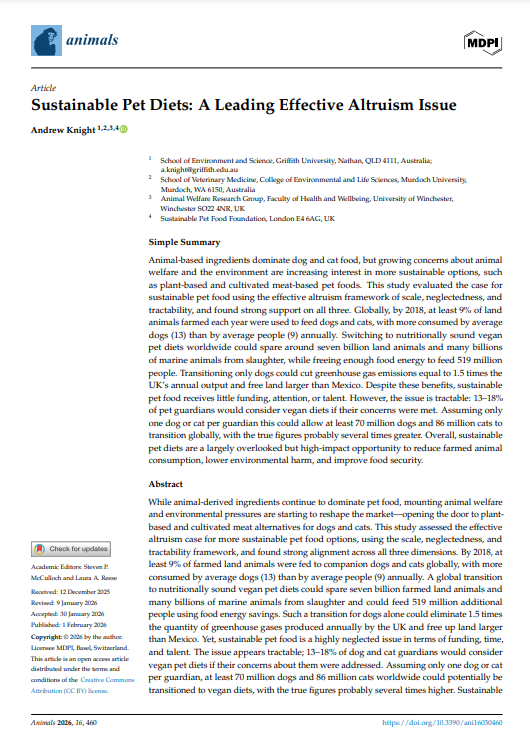
Consumer Acceptance of Sustainable Dog Diets: A Survey of 2639 Dog Guardians
Abstract
Interest in more sustainable diets for the global population of 528 million companion dogs is steadily increasing, encompassing nutritionally sound cultivated meat, vegan, and microbial protein-based dog foods. Factors driving these alternative dog foods include lower impacts on the environment, fewer welfare problems related to intensively farmed animals and wild-caught fish, and potentially superior canine health outcomes, relative to conventional meat-based dog food. Through a questionnaire with 2639 responses, this study aimed to gain insights into dog guardians’ current feeding patterns and dog food purchasing determinants, acceptance of more sustainable dog diets, and sources of information used for decisions about dog diets. Key results included that 84% (2188/2596) of respondents currently fed either conventional or raw meat-based dog food. More than 43% (936/2169) of this group of respondents who answered found at least one of the more sustainable alternative dog foods acceptable, with purchases of these alternatives hinging most commonly upon the nutritional soundness of the products. Cultivated meat-based dog food was the most popular alternative (selected by 24%, 529/2169), followed by vegetarian (17%, 359/2169), insect-based (16%, 336/2169), and vegan (13%, 290/2169) dog food. The top three information sources used to make decisions regarding dog diets were labels/packaging (selected by 42% of all respondents, 1080/2596), scientific articles/books (38%, 989/2596), and business webpages (35%, 900/2596). Numerous human and dog demographic variables had impacts on current diets, acceptance of alternative diets, and information sources used. Notably, human diet and dog diet were the factors most commonly associated with current and potential purchasing decisions, as well as with information sources used. For instance, greater reductions by guardians in the consumption of animals were associated with greater acceptance of more sustainable dog diets. It should be noted that, due to the reliance on convenience sampling and the overrepresentation of respondents from the UK, of female guardians, of respondents with higher education, and of vegan guardians, the reported relative frequencies of subgroups were not fully representative of the global dog guardian population. Association estimates were based on regression analyses to minimize any resultant bias effects.
Mace J. L. Bauer A. Knight A. & Nicholles B. (2025). Consumer acceptance of sustainable dog diets: a survey of 2639 dog guardians. Animals, 15(20), 2988. 10.3390/ani15202988
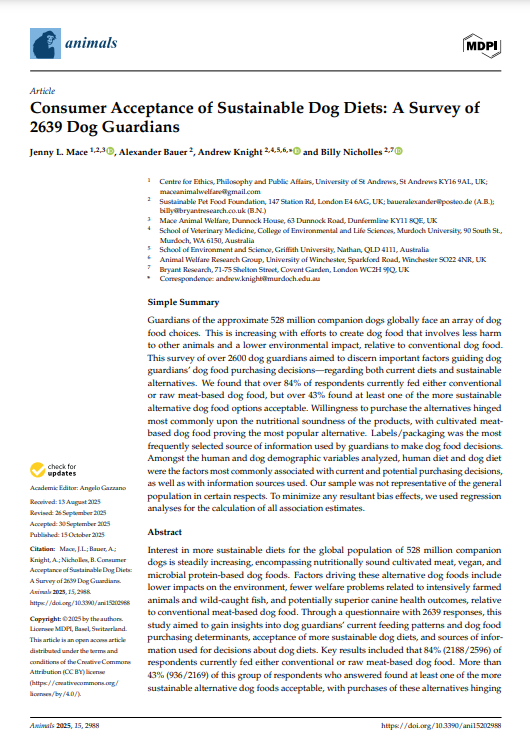
Consumer Acceptance of Sustainable Cat Diets: A Survey of 1380 Cat Guardians
Abstract
There is increasing awareness about the adverse environmental and ‘food’ animal welfare impacts associated with the production of meat-based pet food. However, little is known about cat guardians’ acceptance of more sustainable food choices for the global population of approximately 476 million pet cats. By surveying 1380 cat guardians, this study explored feeding patterns used by guardians, determinants of their cat food choices, and their acceptance levels of more sustainable cat food alternatives. The sources of information used by cat guardians to obtain information about the cat diets they chose were also investigated. Key results included: (1) 51% (620/1211) of cat guardians currently feeding meat-based cat food (raw or conventional) considered at least one or more sustainable alternatives to be acceptable, with cultivated meat-based cat food being the most popular alternative, followed by nutritionally sound vegan cat food; (2) the top five characteristics alternative diets needed to offer to be considered viable were good health outcomes, nutritional soundness, palatability, quality, and environmental sustainability; (3) diet types consumed by cat guardians and their cats were strongly associated; and (4) labels/packaging and veterinarians were the information sources most used, although veterinary staff may have been less trusted as reliable sources of dietary advice by guardians feeding unconventional diets. It should be noted that, due to the reliance on convenience sampling and the overrepresentation of respondents from the UK, of female guardians, of respondents with higher education and of vegan guardians, the reported relative frequencies of subgroups were not fully representative of the global cat guardian population. Association estimates were based on regression analyses to minimize any resultant bias effects.
Mace J. L. Bauer A. Knight A. & Nicholles B. (2025). Consumer acceptance of sustainable cat diets: a survey of 1380 cat guardians. Animals, 15(20), 2984. 10.3390/ani15202984
Poster Summarising Both Consumer Acceptance Studies