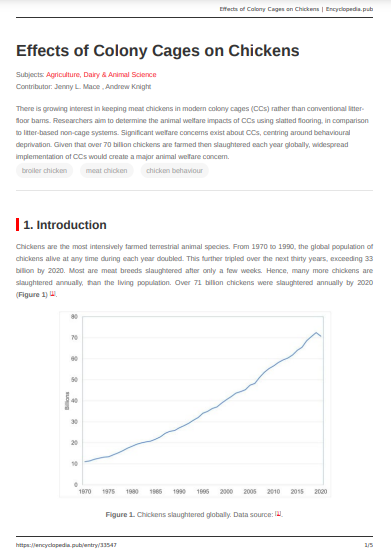
Chickens
Chick welfare in a large, commercial chicken hatchery: A case study
Abstract
Worldwide, approximately 1.8 billion chicks are hatched every month in commercial hatcheries. A typical commercial hatchery is a high-speed and stressful environment. Not only is chick welfare impacted while at the hatchery, but chickens’ early life experiences can also have long-lasting impacts on their welfare after they are moved from the hatcheries. Additionally, the capacity to suffer in chick embryos (i.e., to experience pain, distress, or other prolonged negative welfare) may commence approximately three days before hatching by embryonic day 18—and likely earlier. Based on this knowledge, this case study sought to assess the prevalence of welfare problems in an exemplar US hatchery.
Mace J. L. Knight A. Chick welfare in a large, commercial chicken hatchery: A case study. Open Veterinary Journal, 16(4): 2392-2407 doi: 10.5455/OVJ.2026.v16.i4.41
Development of the capacity to suffer in embryos and chicks: a systematic review of relevant studies
Abstract
Approximately 1.8 billion chicks are hatched worldwide in commercial hatcheries every month. A typical commercial hatchery is a high-speed and stressful environment. Not only is chick welfare impacted while at the hatchery, but also chickens’ early life experiences can have long-lasting impacts on their welfare once they leave the hatcheries. Additionally, chick embryos may have the capacity to experience stress and pain. This study systematically reviewed recent scientific studies exploring the starting point for the capacity to suffer in chicks and chick embryos. It found that the capacity to suffer (i.e., to experience pain, distress, or other prolonged negative welfare states) may commence by embryonic day 18—three days before hatching—and likely earlier. Based on this, serious and widespread welfare problems may exist for the 1.8 billion chicks hatched in hatcheries globally every month.
Mace J. L. Knight A. (2025) Development of the capacity to suffer in embryos and chicks: a systematic review of relevant studies. Front. Vet. Sci Volume 12 doi: https://doi.org/10.3389/fvets.2025.1698528
To what extent do chickens suffer when gassed with CO2?
Abstract
Most chickens slaughtered in the UK are now gassed to death using high concentration CO2, including from RSPCA-certified farms. When undercover footage of gassed chickens emerged, an RSPCA spokesperson stated in The Independent that “the birds in the footage were already unconscious and were not in pain,” despite behavioural signs of consciousness. In this study we examined relevant scientific evidence and concluded that this killing method causes severe and prolonged distress. Instead of defending such methods, we argued the RSPCA could assist in securing the replacement of CO2 stunning/slaughter with argon or nitrogen stunning/slaughter, which is much more humane.
From the backyard to our beds: the spectrum of care, attitudes, relationship types, and welfare in non-commercial chicken care
Abstract
Non-commercial chickens may be the third most numerous pets in Western countries. Yet, to date, there is limited research into their welfare or the care-taking practices and attitudes of their guardians. Using a quantitative questionnaire, this study investigated non-commercial chicken owners’ care-taking practices, attitudes, and relationship types with their chickens. Additionally, the study investigated barriers to optimizing non-commercial chicken welfare. Specific questions were asked regarding niche care-taking practices, including the use of Suprelorin® implants. With 2000+ responses, this study found variable care-taking practices, yet largely positive attitudes towards chickens, and a “personal” (though not “close personal”) owner–chicken relationship, as defined by the Owner–Bird Relationship Scale. The Chicken Attitude Scale, Owner–Bird Relationship Scale, and Care Series scores were found to be correlated with each other, with coefficients ranging from 0.176 to 0.543 (p < 0.001). “Preventing commercial chickens from going to slaughter” was a key motive for chicken care by 56.1% of respondents, with 69.6% of respondents stating they cared for ex-commercial chickens. This study found a higher prevalence of reported poor health conditions and number of deaths relative to prior studies, and egg yolk peritonitis emerged as a leading health condition and cause of death. Moreover, 68.0% had not heard of Suprelorin® implants, and only 6.3% used implants. Most (76.4%) chicken carers followed an omnivorous diet that includes chicken meat/eggs. The results reinforced previous findings concerning a need for more avian-specialist, locally available, and affordable veterinary care for chickens. Research into Suprelorin® implants, rooster-specific care, and tailored requirements of caring for ex-commercial chickens is recommended.
Mace JL & Knight A (2024). From the backyard to our beds: the spectrum of care, attitudes, relationship types, and welfare in non-commercial chicken care. Animals 14(2), 288.
The impacts of colony cages on the welfare of chickens farmed for meat
Abstract
There is growing interest in keeping meat chickens in modern colony cages (CCs) rather than conventional litter-floor barns. Suggested welfare improvements for chickens in such systems include reduced bodily lesions due to lower contact with flooring contaminated with faeces and urine, due to slatted flooring and automated faeces removal. This systematic review sought to determine the animal welfare impacts of CCs using slatted flooring, in comparison to litter-based non-cage systems. Overall, 23 relevant studies were retrieved. From one perspective, the extant research appeared mixed. Fifteen (65%) of these 23 studies identified some form of welfare concern about slatted floors, and thus CCs. Yet, when considering actual welfare indicators assessed, the tallies generated in favour of each housing system were similar. Crucially however, there were incomplete behavioural welfare measures in 100% of the empirical studies reviewed. Accordingly, significant welfare concerns exist about CCs, centring around behavioural deprivation. Given that over 70 billion chickens are farmed then slaughtered each year globally, widespread implementation of CCs would create a major animal welfare concern. Instead of implementing such CC systems, research and development is recommended into improving welfare outcomes of conventional litter barns using different forms of commercially feasible enrichment. As a minimum, a full behavioural analysis, as detailed in the Welfare Quality Assessment protocols, should form a mandatory part of any future studies aimed at assessing the welfare impacts of housing systems on farmed chickens.
Mace JL and Knight A (2022). The impacts of colony cages on the welfare of chickens farmed for meat. Animals, 12(21):2988.
Summary
Mace JL and Knight A (2022). Effects of colony cages on chickens. Scholarly Community Encyclopedia.